Some trips begin with a plan. Mine began with a feeling. After years of living in Manchester, where winter skies are more often grey than glowing, I wanted to see something that reminded me how big the world really is. So I packed warm layers, charged every battery I owned, and set off from Manchester to Norway to chase the auroras.
Why I Left Manchester to See the Auroras
I am used to the city lights of Manchester, the rain on the windows, and the quick pace of everyday life. The auroras, also known as the northern lights, felt like the opposite of all that: silent, slow, and impossible to schedule.
Many travelers from Manchester choose northern Norway because it sits inside the auroral zone, the band around the Arctic where the lights appear most often. The city of Tromsø, well north of the Arctic Circle, is one of the most popular bases for a reason. Long winter nights, a good network of guides, and often-clear skies away from the coast make it a strong bet. The best season runs roughly from late September to early April.
The Journey: Manchester Airport to the Arctic
The journey began early at Manchester Airport, coffee in hand and a camera bag on my shoulder. Depending on the season and the airline, travelers typically connect through Oslo or another European hub before the final flight north, so check current routes before you book.
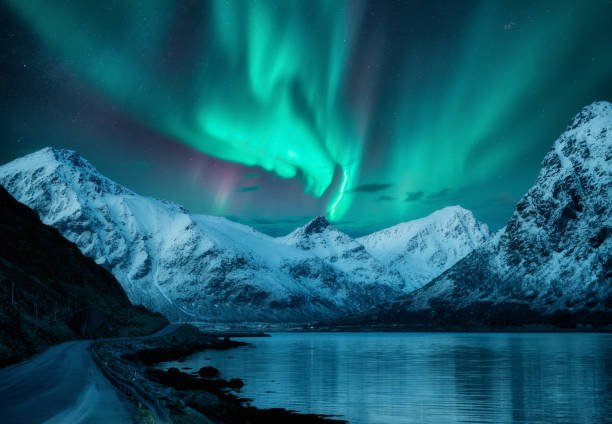
As the plane dropped toward the Arctic, the landscape changed completely. Snow-covered peaks rose out of dark water, and the sky turned a deep blue even in the middle of the day. It felt like arriving on another planet. The cold hit the moment I stepped outside, dry, sharp, and strangely refreshing.
The First Night: Waiting in the Dark
Here is the truth no one tells you: chasing the auroras is mostly waiting. We drove out of town, away from the street lights, and stood in a field of snow with our eyes on the horizon. The first hour brought only stars and a lot of stamping feet.
Then a faint grey arc appeared above the mountains. To the naked eye, auroras can look like a pale cloud at first. But when I lifted my camera and took a long exposure, the screen filled with green. Within minutes, the arc brightened, rippled, and spread across the sky like slow-moving silk.
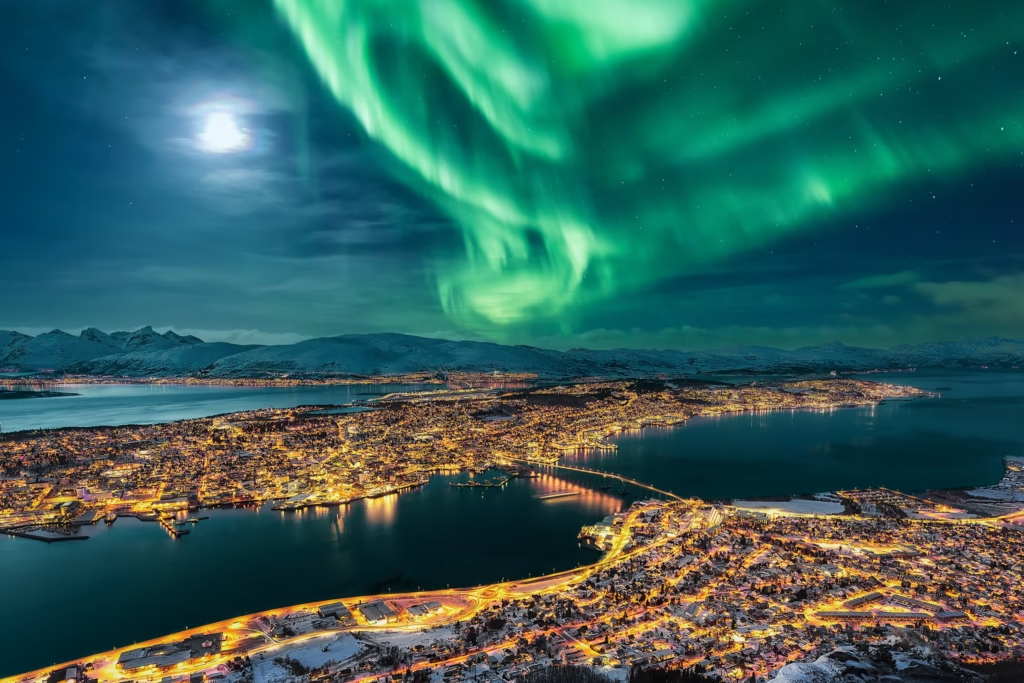
I forgot about the cold. I forgot about Manchester. For a long while, everyone around me simply stood in silence, because words felt too small.
The Universal Phenomenon Behind the Auroras
What moved me most was learning that the auroras are not a rare accident of one place. They are a universal phenomenon, driven by the same physics that operates across the solar system.
How the auroras are made
- The Sun releases charged particles. A constant stream known as the solar wind flows outward, and bursts of it called coronal mass ejections can strengthen the display.
- Earth’s magnetic field guides them. The particles are steered toward the polar regions along magnetic field lines.
- They collide with the upper atmosphere. The particles strike gases like oxygen and nitrogen, which release energy as light.
Why the colors differ
- Green: the most common color, produced by oxygen at lower altitudes.
- Red: produced by oxygen at much higher altitudes, and often seen during strong activity.
- Blue and purple: associated with nitrogen, usually seen at the lower edges of the display.
Auroras exist beyond Earth
The same process happens at both ends of our planet: the aurora borealis in the north and the aurora australis in the south. Beyond Earth, astronomers have observed auroras on Jupiter and Saturn, and signs of auroral activity on other planets too. When I looked up in Norway, I realized I was seeing something that is happening, in different forms, across the solar system. That thought stayed with me long after the lights faded.
What I Learned About Planning an Aurora Trip
If you are travelling from Manchester, or anywhere else, these lessons will save you time and disappointment:
- Stay several nights. Auroras cannot be guaranteed, so more nights means better odds.
- Check the forecasts. Aurora forecasts and cloud-cover maps help you decide where to go each evening.
- Get away from city lights. Darkness matters more than almost anything else.
- Dress for real cold. Thermal base layers, insulated boots, a windproof outer layer, a hat, and good gloves are essential.
- Bring a camera that can do long exposures. A tripod helps, and many modern phones now have a night mode that works well.
- Be patient. Some of the best displays arrive late, after you have almost given up.
- Consider a guided tour. Local guides know where the clear skies are on any given night.
Frequently Asked Questions About Seeing the Auroras
When is the best time to see the auroras in Norway? The main season runs from roughly late September to early April, when nights are long and dark.
Can you fly from Manchester to see the northern lights? Yes. Travelers from Manchester usually connect through a European hub to reach northern Norway, so check current schedules and book early for winter.
Are the auroras guaranteed? No. They depend on solar activity and clear skies, which is why staying several nights improves your chances.
What causes the auroras? Charged particles from the Sun are guided by Earth’s magnetic field and collide with gases in the upper atmosphere, producing light.
Can you photograph the auroras with a phone? Often, yes. Use night mode, keep the phone steady, and let the long exposure capture colors your eyes may not fully see.
Final Thoughts
The journey from Manchester to Norway was about more than ticking off a bucket-list sight. It was a reminder that the universe is always doing something extraordinary, and that sometimes the best thing we can do is travel far enough, and stand still long enough, to notice.
Nabeil Nasr is a Manchester-based writer who shares honest travel stories and practical guidance. Share this post with someone who dreams of seeing the auroras, and tell me in the comments where you want to chase them.